
Case contributed by Dr. Makoto Akiyoshi, Akiyoshi Animal Clinic
Case Information
An 8-year-old neutered male Norfolk Terrier was presented with abdominal distension and collapse. The dog had no previous history of treatment for neoplastic disease but had a history of allergic dermatitis and had been maintained on a hypoallergenic diet. Routine vaccinations, including a multivalent vaccine and rabies vaccine, as well as heartworm prophylaxis, had been continued.
Physical examination revealed marked abdominal distension and pallor of the visible mucous membranes. An abdominal focused assessment with sonography was performed immediately and revealed a splenic mass associated with intra-abdominal hemorrhage, consistent with rupture of the splenic lesion.
Diagnostic Evaluation
Blood testing revealed severe anemia, reflected by a decreased packed cell volume (PCV), thrombocytopenia, coagulation abnormalities, and an increased C-reactive protein (CRP) concentration.
Thoracic radiographs showed no obvious evidence of pulmonary metastatic disease. Echocardiography did not identify an intracardiac mass suggestive of hemangiosarcoma.
Based on the clinical and imaging findings, intra-abdominal hemorrhage secondary to rupture of a primary splenic neoplasm was suspected, with splenic hemangiosarcoma considered a principal differential diagnosis.
On Day 1, a blood transfusion was administered, followed by splenectomy. Histopathological examination of the resected spleen subsequently confirmed splenic hemangiosarcoma.
Given the rupture of the splenic tumor with hemoabdomen and the absence of detectable distant metastatic disease at initial evaluation, the disease was clinically classified as stage II.
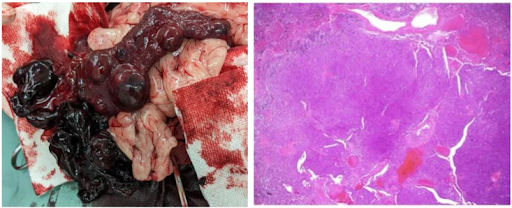
Figure 1. Gross and histopathological findings of the splenic lesion
(A) Gross appearance of the spleen at the time of surgery, showing multiple nodular lesions with extensive hemorrhagic changes.
(B) Histopathological appearance of the resected splenic lesion, consistent with splenic hemangiosarcoma.
Treatment and Clinical Course
Because canine splenic hemangiosarcoma is associated with a substantial risk of metastatic progression following splenectomy, options for postoperative systemic therapy were discussed with the owner.
Potential treatment approaches considered included doxorubicin-based chemotherapy, mitoxantrone, carboplatin, a VAC-based protocol, toceranib, and low-dose continuous metronomic chemotherapy.
The owner expressed a preference for an orally administered treatment that could be given at home and would minimize the need for frequent hospital visits. Based on this preference, toceranib was initiated on Day 15 at 2.8 mg/kg every other day (EOD).
On Day 22, the dog developed diarrhea during treatment with toceranib. Toceranib was temporarily discontinued, and supportive treatment was provided. Because the temporal association alone was insufficient to establish causality, the diarrhea was regarded as a possible treatment-related adverse event.
By Day 28, the diarrhea had resolved. At the owner's request, toceranib was restarted. At the same time, TPG-1 was introduced as adjunctive supportive treatment at twice the standard dose.
Following reintroduction of toceranib together with adjunctive TPG-1, no further clinically apparent gastrointestinal adverse events were documented during the subsequent treatment period.
Serial ultrasonographic examinations also showed no findings considered suggestive of recurrent or metastatic disease for an extended period following surgery.
The dog's general condition remained clinically stable, with preserved appetite, weight gain, and improved activity. These findings were considered consistent with maintenance of a relatively good quality of life during this period.
However, toceranib and TPG-1 were administered concurrently after Day 28. Therefore, no causal relationship can be established between TPG-1 administration and either the absence of subsequent gastrointestinal adverse events or the observed period of clinical stability.
On Day 158, abdominal ultrasonography revealed intra-abdominal hemorrhage and lesions considered suggestive of metastatic disease.
The dog died on Day 189, corresponding to a survival duration of approximately 6.2 months from initial presentation.
Discussion
Canine splenic hemangiosarcoma is generally associated with a poor prognosis because of its aggressive biological behavior and high metastatic potential. Following splenectomy alone, reported median survival times are typically short, commonly in the range of approximately 1–3 months.
Postoperative chemotherapy, particularly doxorubicin-based treatment, has been investigated extensively as a means of prolonging survival. Across published studies, doxorubicin-based protocols have generally been associated with median survival times of approximately 5–7 months, although considerable variation exists according to clinical stage, patient population, treatment protocol, and study design. Median survival times approaching 8–9 months have also been reported in selected cohorts.
Evidence supporting the use of toceranib as postoperative therapy for canine splenic hemangiosarcoma remains limited.
In a prospective study involving dogs with stage I or II splenic hemangiosarcoma, toceranib was administered as maintenance therapy after completion of five cycles of single-agent doxorubicin. The median survival time was approximately 172 days among dogs that proceeded to toceranib treatment. The study did not demonstrate a clear improvement in disease-free interval or overall survival attributable to subsequent toceranib maintenance therapy.
In another retrospective study, dogs with splenic hemangiosarcoma were treated with dose-intensified doxorubicin, and a subset subsequently received low-dose metronomic cyclophosphamide. The median overall survival for the entire study population was approximately 133 days. The addition of metronomic cyclophosphamide was not associated with a statistically significant improvement in progression-free or overall survival.
These findings illustrate that additional targeted or metronomic approaches after doxorubicin treatment have not consistently demonstrated a marked survival benefit in canine splenic hemangiosarcoma.
In the present case, intravenous cytotoxic chemotherapy such as doxorubicin was not administered. Instead, postoperative toceranib was initiated on Day 15, followed by the addition of adjunctive TPG-1 on Day 28.
Suspected metastatic progression was identified on Day 158, and the dog survived for 189 days from initial presentation.
The observed survival duration was within the range reported in some historical cohorts receiving postoperative systemic therapy. No inference regarding comparative treatment efficacy can be made from this observation.
Published cohorts differ substantially with respect to clinical stage, patient characteristics, treatment protocols, supportive care, follow-up schedules, definitions of clinical progression, and study design. Furthermore, the survival time of an individual dog cannot be directly compared with median survival estimates derived from separate study populations to determine relative treatment efficacy.
Similarly, because TPG-1 was introduced concurrently with the reintroduction of toceranib and no untreated or comparator condition was available, the independent contribution of TPG-1 to treatment tolerability, tumor control, quality of life, progression-free survival, or overall survival cannot be determined from this case.
The absence of recurrent clinically apparent gastrointestinal adverse events after Day 28 also cannot be attributed specifically to TPG-1, because the initial diarrhea had resolved before treatment was resumed and spontaneous resolution, supportive treatment, treatment interruption, or other factors may have contributed.
Nevertheless, this case documents that postoperative administration of toceranib with adjunctive TPG-1 was feasible in this individual dog. Following reintroduction of toceranib, no further clinically apparent gastrointestinal adverse events were documented, and the dog maintained a clinically stable condition for several months before findings suggestive of metastatic progression were identified.
Because this report describes a single clinical case, it cannot establish the efficacy of either toceranib or TPG-1, alone or in combination, for canine splenic hemangiosarcoma.
Further prospective studies involving larger numbers of dogs and appropriate comparator groups would be required to determine whether adjunctive TPG-1 is associated with measurable differences in treatment tolerability, quality of life, progression-free survival, or overall survival in dogs with splenic hemangiosarcoma.